

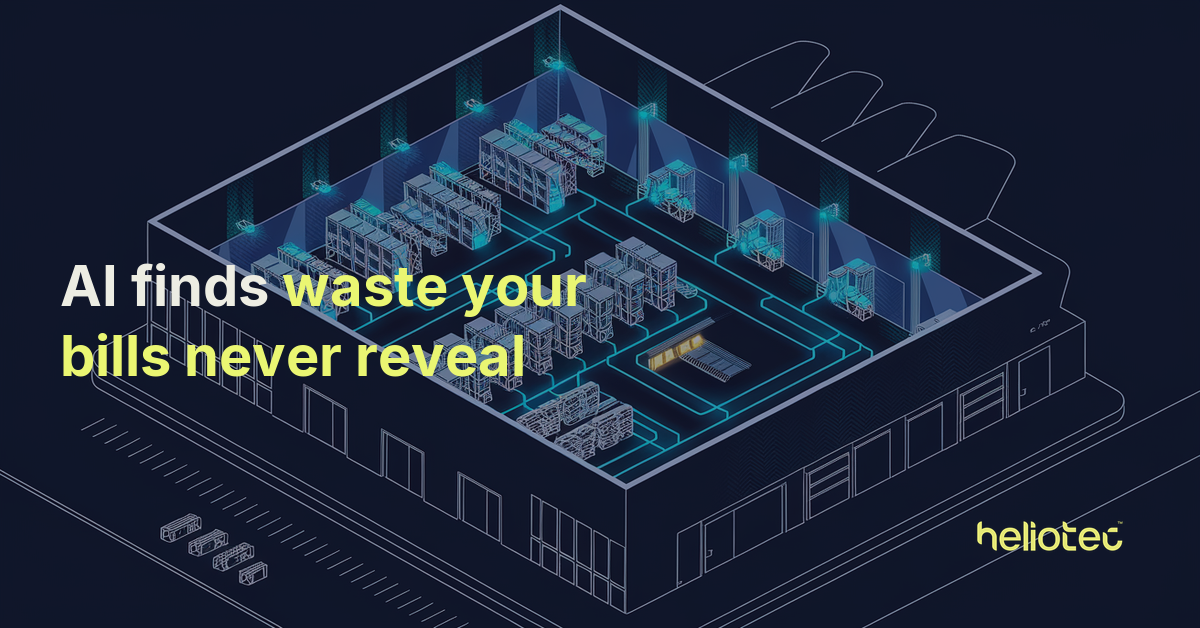
The Six-Figure Blind Spot Hiding in Your Distribution Centre
Most logistics operators think they have a reasonable handle on their energy costs. They get the bills, they’ve perhaps negotiated a decent tariff, and they’ve ticked the LED lighting upgrade off the list. What they don’t have — and what’s quietly costing many of them six figures a year — is visibility into what’s actually happening inside their buildings, hour by hour, asset by asset. That’s the blind spot. And the frustrating part is, you don’t need a capital investment programme to find it.
Why Logistics Facilities Are Particularly Exposed
Warehouses and distribution centres are deceptively complex energy environments. Shift patterns change. Loading bay doors are left open. Refrigeration units cycle erratically. Compressed air systems leak. Heating runs long after the last pallet has moved. None of these individually looks catastrophic on a monthly bill — but together, across a large facility, they add up fast.
Consider a typical 75,000 sq ft distribution centre running around £180,000 in annual utility costs. Research suggests that operational blind spots in facilities of this type routinely account for six-figure losses each year — waste that sits undetected precisely because traditional energy management tools aren’t granular enough to catch it. Warehouse buildings make up 17% of the UK’s commercial building stock, yet energy monitoring adoption in the sector remains low compared to manufacturing or retail. That gap represents both a significant problem and a real opportunity.
What Integrated AI Monitoring Actually Reveals
The difference between a basic half-hourly meter read and integrated AI energy monitoring is the difference between a bank statement and a full financial audit. One tells you what you spent; the other tells you where, when, and why — and flags the anomalies you’d never spot manually.
Facilities that implement integrated logistics energy monitoring — connecting consumption data with operational context like shift schedules, throughput, and equipment run times — consistently outperform those using standalone energy management tools. The research is clear: integration delivers 15–20% better outcomes than point solutions working in isolation. That improvement comes from the AI’s ability to detect patterns across data streams that no human team has the bandwidth to correlate at scale. A rogue chiller running overnight. A conveyor system drawing peak-rate power during an avoidable window. Lighting zones active in unoccupied areas across a weekend. These findings don’t require a capital project — they require visibility.
The Zero-CapEx Case for Acting Now
One of the most common conversations I have with logistics energy managers and ops directors is around budget cycles. The assumption is that deploying energy monitoring infrastructure means a capital expenditure conversation, a long procurement process, and a multi-year payback calculation. It doesn’t have to.
Heliotec’s model is built specifically to remove that barrier. We deploy AI energy monitoring with no upfront CapEx — the value is captured in operational savings from day one, and the commercial model reflects that. For a distribution centre already spending £180K a year on energy, even recovering a fraction of that six-figure waste pays back quickly and measurably. The business case doesn’t need to be complex. It just needs to be visible.
Conclusion: The Cost of Not Looking
The logistics sector is under margin pressure from every direction — fuel, labour, rates, and now energy. The operators who move first on energy visibility won’t just save money; they’ll build a structural cost advantage over competitors who are still waiting for their next quarterly bill to tell them something’s wrong.
If you manage energy across a distribution network and you’re not yet getting asset-level visibility into your consumption, the question worth asking isn’t whether you can afford to implement monitoring. It’s whether you can afford not to. We’re happy to walk through what that looks like for your sites — no obligation, no CapEx required.